
Durham
What to see and where to eat in Britain's most charming university town

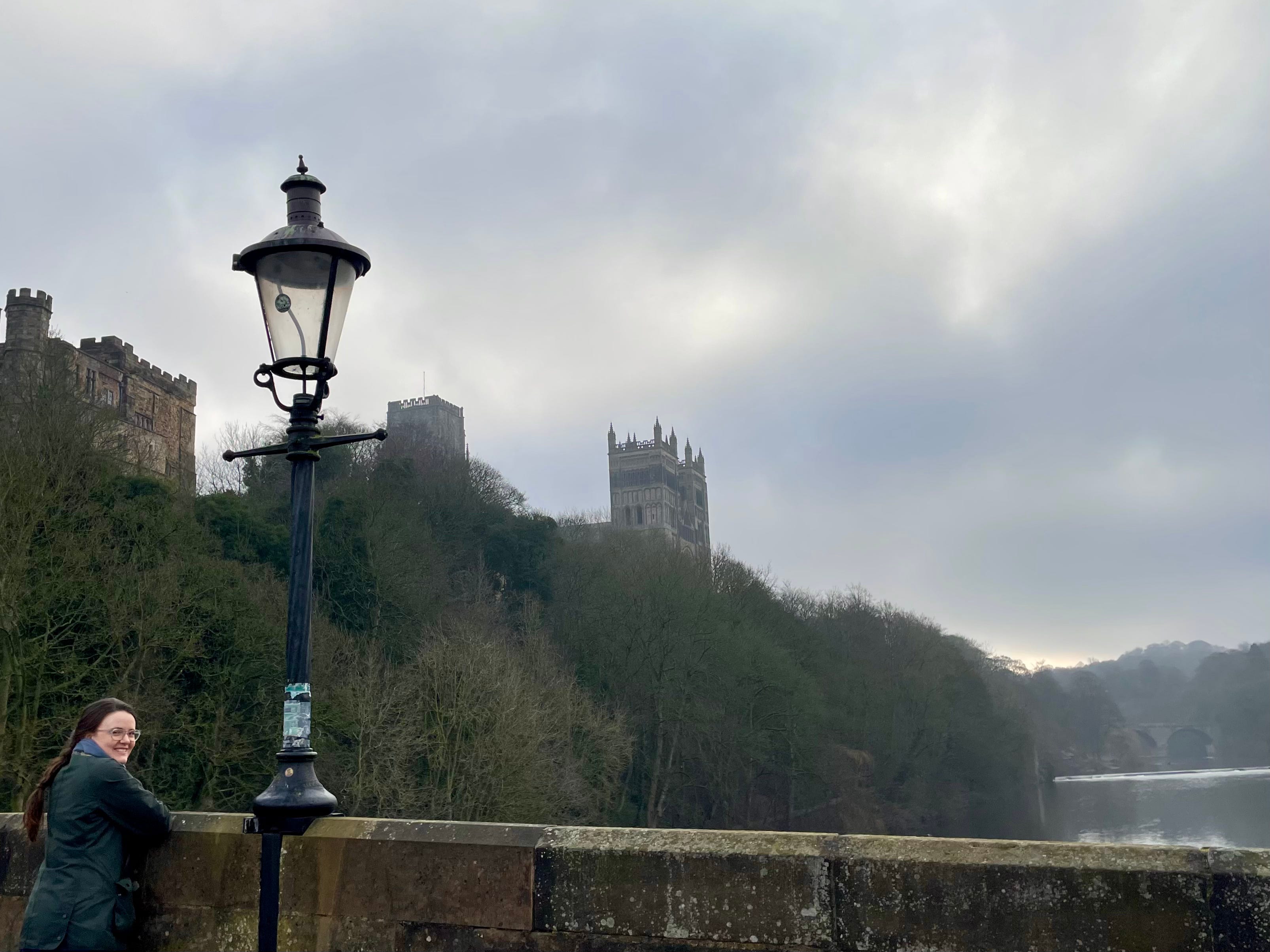
Hello, all! Happy Saturday, and a warm welcome to readers who have joined me in the past week. I was slightly surprised by the outpouring of messages and comments on my post Not Everyone has to be Everything. I’m glad it seemed to resonate with many of you, and I appreciated the thoughtful engagements, additions, and clarifications that were brought up in the comments. I also really appreciated the emails I received from readers in Minnesota who are grappling with what it means to live into their “offices” and callings as good neighbors, family members, and educators in these challenging times. You are in my prayers.
Considering the response to last week’s letter, I’d like to know: is this type of writing something you would like to see more of here? I don’t know what I mean by this “this type of writing” exactly, but perhaps writing that is a more topical, idea or argument oriented, and perhaps reflecting on current cultural movements?
Since there’s a fair few new faces, I thought I’d give a very brief introduction to myself. My name is Joy Marie Clarkson. I am a writer, editor, and podcaster living in London. I work at the Theology and Religious Studies department at King’s College London and am an editor at Plough. I’ve written two books, one about happiness and one about metaphors. I’m currently working on a collection of short stories about the interior lives of women in Christian history (due February 1st…!). I host the podcast Another Life for Plough, and before that I hosted my own podcast Speaking with Joy. I am from (and always missing) the Colorado mountains.
I write about all sorts of things here. Often, I simply write about life as an expat here in London. I moved to East London last year after almost a decade of living in Scotland. It was in Scotland that I started to write a letter every Saturday, as a welcome distraction from writing my doctoral dissertation in theology. Through that habit, I encountered many lovely people, many of whom have read my weekly ramblings for the better part of a decade. Since then, a lot has happened: I finished my doctorate, I wrote my books, I started as an editor Plough, I got married, and I started working at King’s College London. And I’m still writing.
This week, I thought I’d return to series I’ve been trying to develop from time to time, which is to share some little travel tips for my favorite places in the UK. The two emails I receive most often are people asking advice on graduate school in the UK and where to visit in the UK. I wrote a blanket response to the former here, but the latter takes significantly more time as there are many wonderful corners of the small Island that is the United Kingdom, and I certainly haven’t visited all of them. However, as I have time and inspiration, I’ve been trying to write up a post for various cities in the UK— about where to visit, eat, and avoid. Most recently, I wrote about one of my top three cities in the UK: Manchester. And today I want to share with you about Durham, which is, I think, the most charming of the British Universities— and yes, I mean more charming than Cambridge and Oxford! This past week, my husband had a business meeting up North, so I joined him and we stopped in Durham on the way down to meet with an author I had commissioned to write for the upcoming issue of Plough. We stayed for an extra night to enjoy Durham— and what a place to enjoy!
Durham
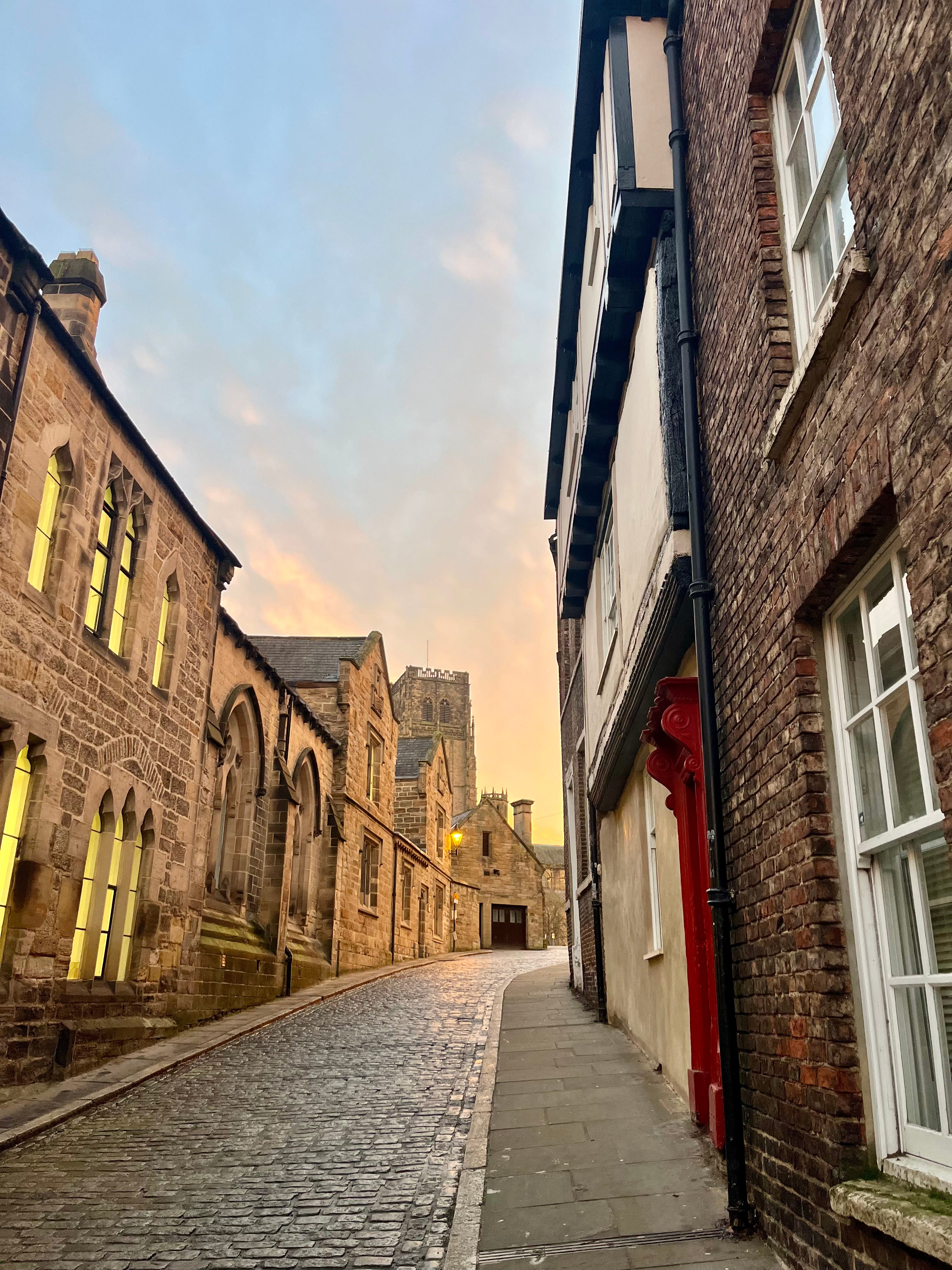
When many Americans think of the UK, they think of Harry Potter and Hogwarts. And Durham is more Harry Potter than Harry Potter, more Hogwarts than Hogwarts itself. You approach the city by train. Across a deep valley and a wide river, you spy the resplendent Durham Cathedral, presiding over the city and countryside in splendour and seriousness. The city itself is placed on top of a hill, so to get there from the train station, you have to descend precarious series of stairs, and then cross a bridge to the other side of the river, where you begin to ascend into the city once again. The city is cobbled and pedestrianised, cars occasionally passing by as obvious intruders in a city that was obviously made for hoof and foot. Once in the city centre, you meet a tangle of roads and footpaths that make their way up and around the hill to the Cathedral. The cobbled streets, winding their way sharply up the hill are more Diagon alley than Diagon alley. Wear good walking shoes when you come to Durham— in some places, you may even need to secure yourself against the narrow walls, so narrow and steep are the winding pathways!
Keep reading with a 7-day free trial
Subscribe to Joy Clarkson to keep reading this post and get 7 days of free access to the full post archives.